What Is Changing?
Effective July 1, 2026, the Council began transitioning to three districts:
South District
Mount Rubidoux and Tahquitz
West District
Old Baldy and Temescal
East District
Sunrise, Gray Arrow, and High Desert
South, West, and East are interim names. Permanent names will be selected later. The new structure will become fully effective January 1, 2027.
What This Means for Your Unit
Your unit remains local.
Your pack, troop, crew, or ship keeps its:
- Leadership
- Chartered organization
- Unit number
- Meeting location
- Traditions
- Community relationships
The goal is to strengthen the support surrounding your unit through stronger volunteer teams, commissioner service, recruiting assistance, training, advancement support, and district programs.
Why the Council Is Making
This Change
The realignment was developed through a volunteer-led process and approved by the Council Executive Board.
The committee reviewed:
- Youth and adult membership
- Volunteer leadership capacity
- School district boundaries
- Geography
- Unit needs
- Opportunities for future growth
The goal is to create districts that can build complete volunteer teams and provide more consistent support to units.
How This Supports Our
Strategic Plan
The Council’s Strategic Plan calls for an outstanding Scouting experience for a growing membership, delivered sustainably.
The realignment supports that plan by helping the Council:
- Build staffed and trained district teams
- Strengthen commissioner service
- Recruit and retain more volunteers
- Support membership growth
- Improve program delivery
- Strengthen relationships with schools, chartered organizations, and community partners
This structure is a tool to help volunteers deliver the mission of Scouting America to more young people.
District Maps
Find Your District
View the District listings by City or Zip Code.
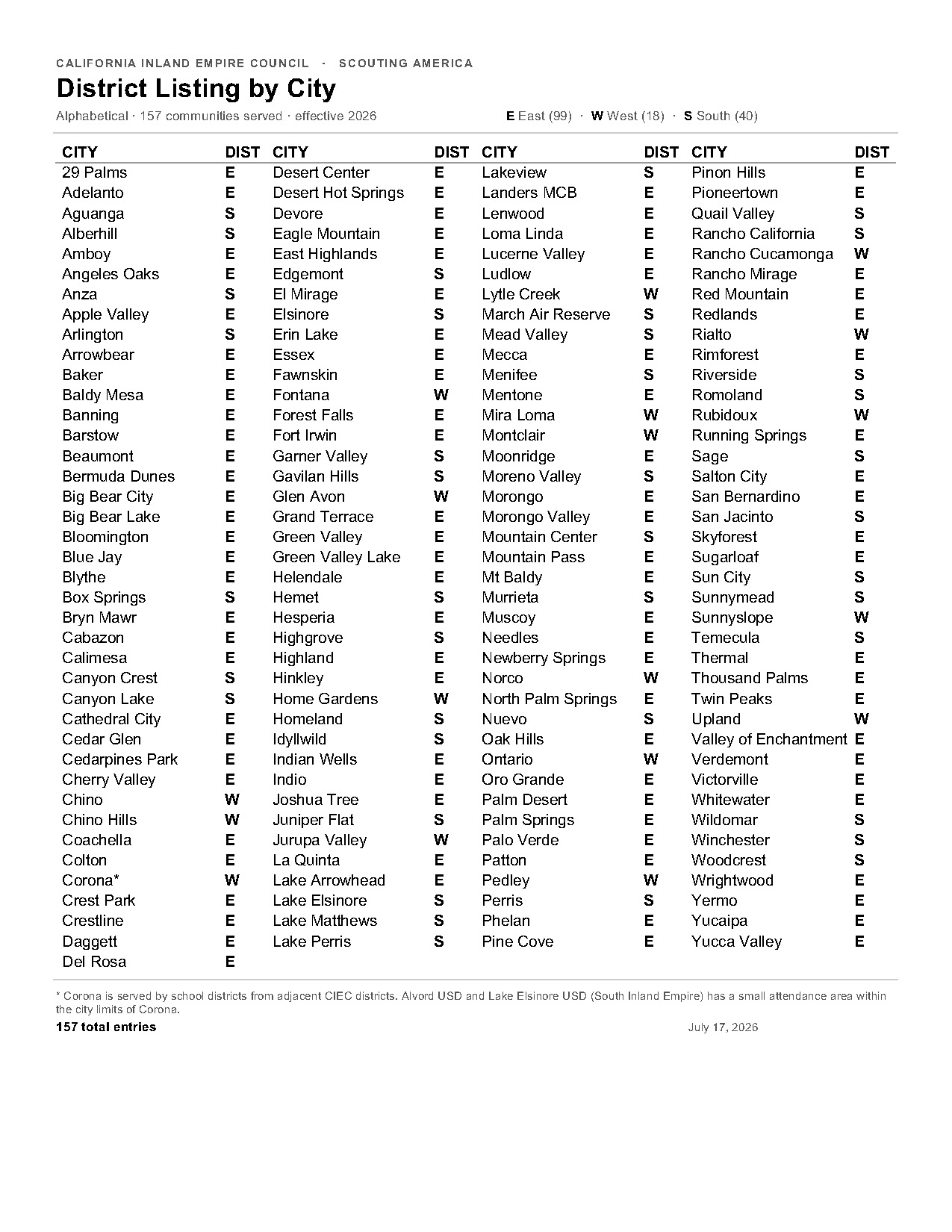
By City
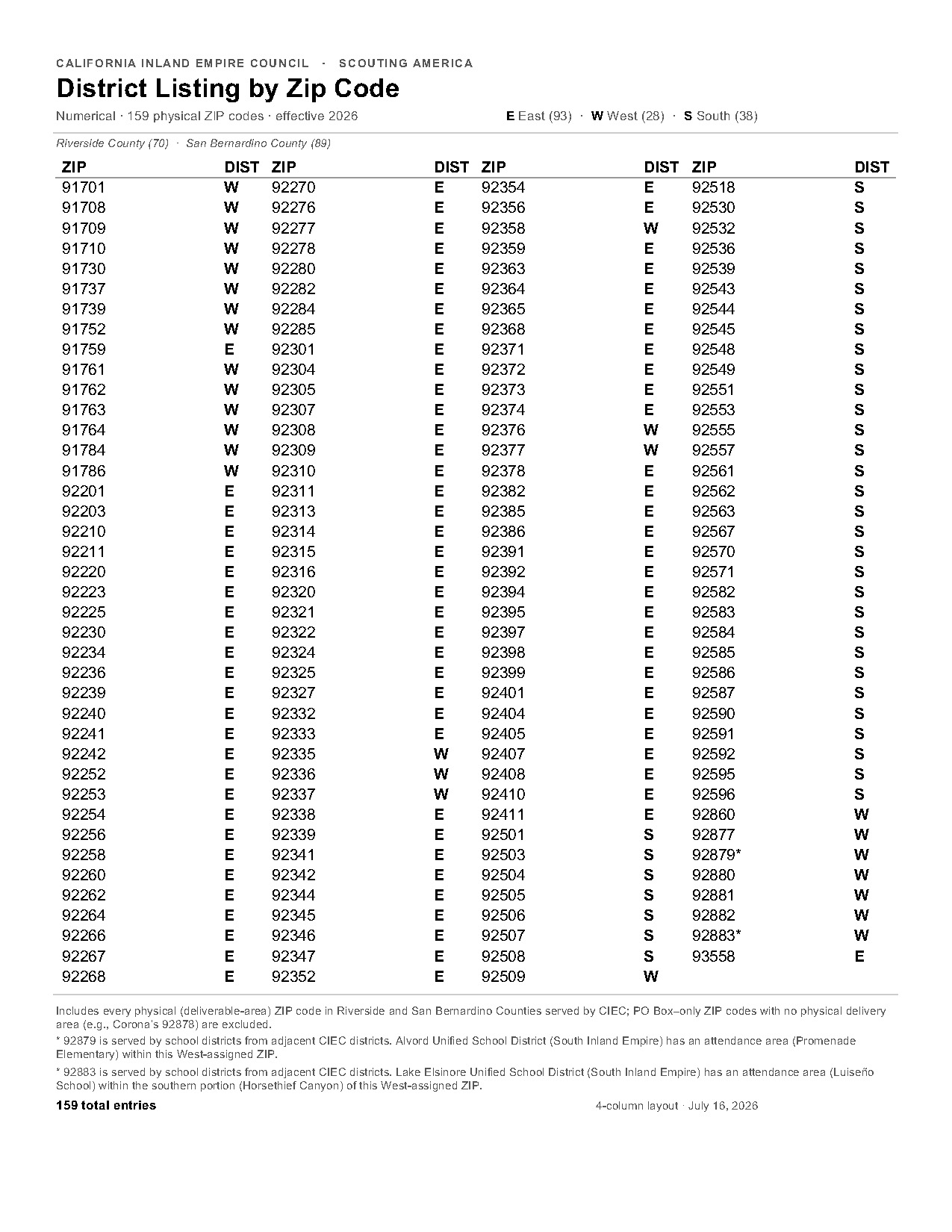
By Zip Code
Frequently Asked Questions
The realignment includes adjustments to: District boundaries, District leadership structures, Volunteer committees, and Professional staff assignments.
The short answer is now, and over the next few months. By January 2027, District Committees should be combined and Roundtables should be combined with remote meeting capabilities.
The long answer is that district committees will begin working together this summer and fall to prepare for the merging of the committees. Here is a timeline of the transition:
July: Meeting at Council Coordinated Meeting to discuss transition and to meet with counterparts.
August: Existing District Chairs agree on an equal number of nominating committee members from each of the old previous districts. District Committees and Commissioner Teams begin meeting together to discuss the transition.
September: Nominating Committee members should be announced to the Districts at Roundtables and Committee meetings and all present should be encouraged to recommend Scouters to District Committee positions or District Members-at-Large to those Nominating Committee members. Nominating Committee members should be encouraged to attend the District Committee meetings and Roundtables so they can get to know the existing District Committee members better.
October: Nominating committees meet with the District Executive, build a slate of candidates, and secure nominees’ approval. District Committees and Commissioner Teams continue working together and should have a plan in place for the District Annual Meeting and the first few Roundtables of 2027.
November: District Annual Meetings. Nominating committees present the slate for approval by the existing District Members-at-Large. Districts may elect to have a combined Roundtable after the District Annual Meeting.
Updates will be shared regularly through: Council email, District newsletters, Roundtables, The CIEC website, Social media, Commissioner communications, and Virtual/in-person town hall meetings.
The primary purpose of this realignment is to improve service to units. By strengthening volunteer teams and aligning resources more effectively…
The permanent district names will be selected after the new district leadership teams have had an opportunity to establish their identity.
Yes. The Realignment Committee is made up entirely of volunteers across all geographic regions within our council. Surveys were sent out to gather feedback and this feedback was discussed at great length within the committee.
Absolutely. Merit badge events, training opportunities, and other district programs will continue.
Roundtables will continue to be an important part of supporting unit leaders. The exact format and locations may evolve over time…
Current advancement committees in the existing districts will continue to operate as they have prior to realignment… The Cahuilla lodge will align to match the new structure as of January 1, 2027.
In many cases, yes. The new districts will bring together volunteers from multiple legacy districts… Our goal is to build on existing relationships—not replace them.
Scouting continues to evolve, and now is the right time to align our districts to better serve youth, families, volunteers, and chartered organizations.
The goals of this realignment are to:
- Strengthen volunteer teams
- – Improve unit service
- – Reduce duplication of effort
- – Better align professional support
- – Create sustainable district structures for future growth
This decision is intended to position our council for long-term success, and be a leading example for Scouting America.
Our volunteers remain incredibly important. Existing district volunteers will be invited to continue serving and help shape the new district structure. This is also an opportunity for new volunteers to participate in events, roles and where they are interested. Their experience and knowledge are valuable to the success of the transition.
No change to the current structure: Parents should reach out to their unit leaders, units should reach out to your Unit Commissioner, District committee members should reach out to their current District Key 3.
Updated district maps are available on the council website. You can use the maps to determine whether your unit is part of the East, West, or South District.
No. The California Inland Empire Council remains financially stable.
Yes. As the new districts are organized, additional leadership and committee positions may become available.
Absolutely. In fact, this is one of the best opportunities in recent years to become involved.
Not immediately. Current Unit Commissioner assignments will remain in place during the transition unless you are notified otherwise.
No. The annual charter renewal process will remain the same and will continue to follow Scouting America’s national procedures.
Our council last completed a major restructuring in 2017… A structure built to support that earlier scale is difficult to staff and sustain at today’s membership levels…
Professional staff will support the implementation of the transition plan developed by the District Realignment Committee.
There are MANY factors that contributed to our rapid loss of membership. The departure of a key partner, The Church of Jesus Christ of Latter-day Saints, in 2019 and the COVID-19 pandemic in 2020 are just two. We believe that if we set up volunteer leaders for success we’ll be able to provide a better program to the youth in our council. With a better program, we will retain existing youth and recruit more.
We developed our plan around a clear target: when a district can reach roughly 1,000 Cub Scouts — about 1% of the school-age youth within its boundaries — it has the youth, families, and adult volunteers to run a strong, district-focused program. Most of our existing districts have been at that level. Over 1,000 Cubs, multiple day camps, 300 youth at Webelos Woods, and multiple camporees are all within reach. Each of the three districts has enough addressable youth to grow toward that 1% / ~1,000-Cub mark.
Why not two, and why not stay at seven? At a 1% Cub market share, a two-district plan produces districts so large and spread out that in-person connection suffers and too many adults can create a bystander effect. Staying at seven is no longer realistic either — with about 1,778 registered adults council-wide, we cannot field a complete Key 3 and core committees in seven districts. Three is the structure that balances addressable youth, volunteer staffing, and in-person engagement. After months of review, the CIEC realignment committee proposed the three-district plan, and the Council Executive Board approved it.
Yes. One of the goals of this realignment is to preserve and build upon the traditions that have made each of our legacy districts successful.
Like many organizations, the council needed time to understand how membership, volunteer engagement, and program participation would stabilize…
The council will continue to evaluate the effectiveness of the new district structure throughout the 2027–2028 Scouting year.
Have a question about district realignment?
Please fill out the following form.
Error: Contact form not found.